Weather
Philippines Weather: When to Go, Climate and Rain Island by Island
Philippines weather explained: monsoons, rainy season, a month-by-month guide, rainfall island by island, typhoons and live conditions before you book.
13 September 2026 · 14 min read

The short answer
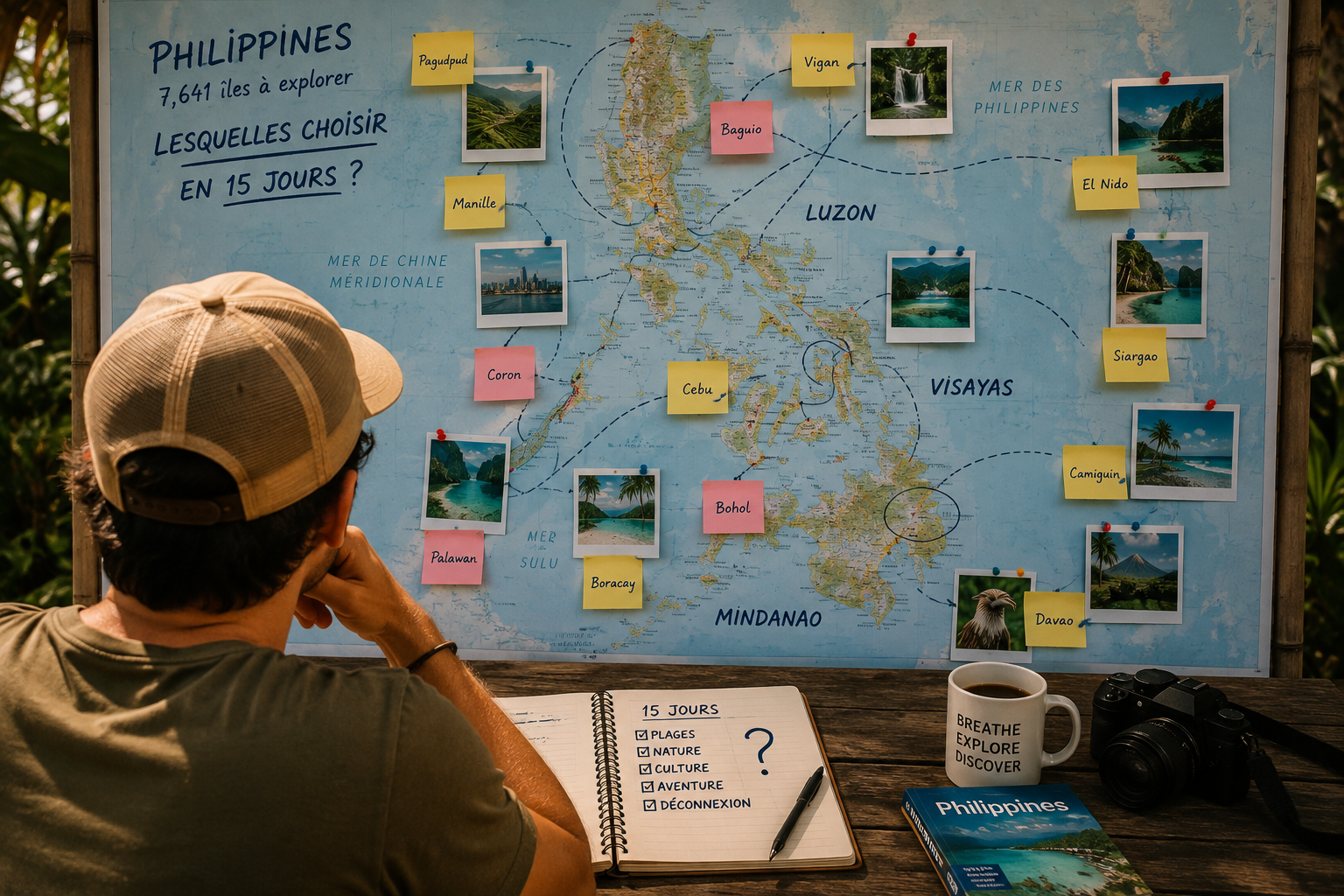
There is no single Philippine weather. The archipelago stretches more than 1,800 km from north to south and counts over 7,000 islands: at the very same hour it can pour on one coast and stay sunny on the other, two hours away by boat.
If you still want a simple answer: from January to April, most classic destinations (Palawan, Boracay, Bohol, Cebu, Siquijor) give you the highest odds of dry days. From June to October the southwest monsoon soaks the western coasts, while Siargao and the east coast of Mindanao, Samar and Leyte often enjoy their best stretch. These are probabilities, not guarantees.
Before you book and again before you fly, check the real conditions: see live weather in the Philippines, destination by destination, with current conditions, a 4-day outlook and a radar map.
What the official source says (PAGASA)
The national weather agency, PAGASA, describes the Philippine climate as tropical and maritime: hot, humid and rainy. The national mean temperature, leaving aside Baguio in the highlands, sits around 26.6 °C. January is on average the coolest month, May the warmest.
Nationally, PAGASA broadly describes a rainy season from June to November and a dry season from December to May. But the agency immediately adds the crucial part: there are four climate types, defined by how rainfall is distributed across the year.
- Type I: two pronounced seasons, dry from November to April, wet the rest of the year. That is the western coast, exposed to the southwest monsoon.
- Type II: no dry season at all, with maximum rainfall from November to January. That is the eastern coast, facing the northeast monsoon.
- Type III: a short dry season of only one to three months, and no pronounced maximum rainfall otherwise.
- Type IV: rainfall spread fairly evenly throughout the year.
This is why "December to May is dry everywhere" becomes false the moment you turn it into travel advice. Part of the country simply has no real dry season.
Amihan and Habagat, the two monsoons, explained simply
Philippine weather comes down to two winds.
The Amihan is the northeast monsoon. It blows roughly from November to February, brings cooler and drier air over much of the country, but soaks the eastern and northeastern coasts that take the wind head on.
The Habagat is the southwest monsoon. It dominates roughly from June to September, carries moisture off the South China Sea and mainly drenches the western coasts: Palawan, Boracay, western Luzon, Manila.
Remember the logic rather than the calendar: rain falls first on the side of the island facing the wind of the moment. It also explains the sea: a sheltered beach in February can be choppy in August, and the other way round.
Why El Nido's weather tells you nothing about Bohol
El Nido, Coron and Boracay face west: their most reliable window runs from January to April, and the Habagat can hand them grey days in July and August. Siargao, on the eastern side, works almost in reverse: its best conditions often fall between April and October, while the Amihan brings wind and showers in December and January.
In between, the Central Visayas (Bohol, Cebu, Siquijor, Camiguin) are more moderate: they get a share of both regimes without a harsh extreme. That is one reason they stay workable nearly all year.
Practical consequence: an itinerary lining up Palawan, Siargao and Bohol at the same time necessarily puts one of them out of season. That is exactly what Filiscore, my free itinerary analysis tool, measures.
Month-by-month guide
The notes below are observed tendencies at national scale. They do not replace a forecast.
Destination by destination
Bohol and Panglao
A moderate regime with no abrupt dry season. February to May are the steadiest months, July to October alternate short showers and full sun. One of the rare bases that stays comfortable in low season. Details in my Bohol guide.
Palawan: El Nido, Coron, Port Barton
West facing, so January to April are the reference months for island hopping. In July and August tours are cancelled or shortened more often because of rough seas. See El Nido, Coron and Palawan.
Boracay
Same logic: peak season from November to April, sheltered sand and calm water on White Beach; from June the Habagat pushes wind and swell onto the western shore. Boracay.
Siquijor
A small sheltered island, often milder than the coasts around it. February to May is the steadiest window. Siquijor.
Cebu
Cebu is a long island: the north and Bantayan are drier, the south and Moalboal take more showers in autumn. Broadly practicable year round. Cebu.
Camiguin
A very wet climate, with rain spread across the year. The safest window runs from March to June.
Siargao
East facing: April to October is the best stretch for fine weather, while surf swell peaks from September to November. December and January bring wind and showers. Siargao.
Leyte and Samar
No pronounced dry season, with maximum rainfall from November to January. May to September are the safest months.
Manila
West facing, so dry from December to April and very humid from June to September, with urban flooding possible after a sustained Habagat.
For each of these areas you can check today's conditions and the 4-day outlook: see live weather in the Philippines.
Typhoons: the real risk, without the drama
The Philippines is among the countries most exposed to tropical cyclones in the world. The most active season runs roughly from July to November, and tracks mainly hit Luzon, the eastern seaboard and the northern Visayas. Mindanao and Palawan are statistically the least affected areas.
What this means for a traveller: a typhoon almost never arrives as a surprise. It is announced days in advance, warning signals are published by PAGASA, and the main effect on an itinerary is cancelled ferries and domestic flights rather than direct danger.
My three rules: never schedule an international flight the day after a domestic one during typhoon season, keep a buffer night in Manila or Cebu, and take insurance covering trip interruption.
How to read a tropical forecast
This is what cancels the most trips for nothing. In the tropics, a rain icon does not mean a day of rain.
- A 70% chance of rain usually means one shower during the day, often under an hour, not seven hours of water.
- Look at expected millimetres rather than the icon: 2 mm is a passing shower, 40 mm is a genuinely wet day.
- Look at the timing: in the wet season rain mostly falls late afternoon and at night. Mornings usually stay usable.
- Look at wind, not only rain: gusts and sea state cancel boat tours far more often than clouds do.
That is exactly why I built Philippines Live: you pick your destination and see, on a single page, the feels-like temperature, humidity, wind, expected rain, the 4-day outlook and an animated radar map, with nothing else to click.
What I have observed on the ground since 2021
This section is personal experience, not a statistic. I have lived in the Philippines since 2021, travelled more than 50 islands and visited around 150 hotels.
What I see is that "December to April equals good weather" and "June to October equals bad weather" are far too crude to build an itinerary on. I have had grey February weeks in Siargao and near-perfect Augusts in Anda. I have also watched travellers cancel Bohol in September based on a monthly average, when the actual window was good.
The variable that really ruins a trip is almost never rain: it is the itinerary. Too many islands, badly placed transfers, a windward coast chosen at the wrong time. Weather can be worked around, poor logistics cannot.
What to do with all this before booking
- Choose a coast facing (west or east) that matches your dates, rather than a wish list of islands.
- Test your plan with Filiscore: season, transfers and wasted days are scored automatically.
- Compare periods in my best time to visit the Philippines guide.
- Place the islands relative to each other on the interactive map.
- In the days before departure, follow real conditions on Philippines Live.
Frequently asked questions
- When is the best time to visit the Philippines?
- For a first trip combining Palawan, Boracay and the Visayas, January to April gives the highest odds of dry days and calm seas. If Siargao or the east coast is your priority, aim for April to October instead. There is no single best period valid for the whole archipelago at once.
- When is the rainy season in the Philippines?
- Nationally, PAGASA places the rainy season broadly from June to November and the dry season from December to May. That rule does not hold everywhere: some regions have no pronounced dry season at all, and others receive their maximum rainfall between November and January.
- Can you travel to the Philippines during the rainy season?
- Yes, if you adapt the route. In July and August, favour the Central Visayas, Siargao or the south over an all-Palawan circuit. Showers are often short and concentrated late in the day, rates are lower and sites are far quieter.
- What is the typhoon risk during my trip?
- The most active cyclone season runs from July to November, with tracks mainly affecting Luzon, the east coast and the northern Visayas. Typhoons are announced days ahead by PAGASA. The main impact on a traveller is cancelled ferries and domestic flights, which is why a buffer night before an international flight matters.
- Is the weather the same across the whole Philippines?
- No. PAGASA distinguishes four climate types based on rainfall distribution. West-facing and east-facing coasts do not receive rain in the same months, which is why El Nido can be under rain while Siargao is sunny, and the reverse six months later.
- How can I check the actual weather before I go?
- Use Philippines Live: pick your destination and get current conditions, a 4-day outlook and an animated radar map on the same page. For official cyclone warnings, always refer to PAGASA bulletins.

See live weather in the Philippines
Current conditions, a 4-day outlook and a radar map, destination by destination.
Open Philippines Live